Selling a House With Foundation Problems in Spring Hill, FL: Sinkholes, Settling and Your Real Options
A long crack runs up the block wall in the garage. The back bedroom door won’t latch anymore. Maybe a neighbor a couple streets over had a hole open up in the yard last spring and now every new crack in your own house makes your stomach drop. If you own a home in Spring Hill you know this feeling better than most Floridians do.
Here’s the good news first. You can sell a house with foundation problems in Spring Hill. People do it every month. The house might have a sinkhole that was stabilized years ago or a fresh crack nobody has tested or an insurance claim that got paid while the money went somewhere other than the repair. Each of those homes can be sold. What changes is who buys it and how much paperwork comes along with it.
This guide covers why Spring Hill gets so many sinkholes, how to tell ordinary settling from the real thing, what Florida insurance actually pays for, what you have to tell a buyer and how the numbers compare when you fix the house first versus selling it the way it sits.
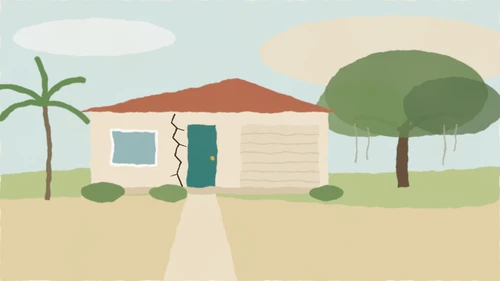
One stair-step crack beside the front door is all it takes to start the worrying.
Why Spring Hill Sits in Sinkhole Alley
Spring Hill was built fast. The Deltona Corporation and the Mackle Brothers started it in 1967 as a planned community and sold lots all over the country through heavy advertising (Wikipedia). The original entrance is still marked by the waterfall at US 19 and Spring Hill Drive. By the 2020 Census the place had grown to 113,568 people and most of their houses sit on a few feet of sand and clay over limestone.
That limestone is the whole story. Nicholas Albergo teaches at USF and he describes Florida’s ground as a layer cake of sand, clay and limestone. The limestone wears away over time and that’s what sets the stage. Rainwater picks up a little acid as it soaks through the soil and over thousands of years it dissolves pockets and caves in the rock. When the sand above starts draining down into those voids you get a sinkhole. Sometimes it’s a slow saucer-shaped dip that takes years. Sometimes the cover gives way all at once. The Florida Geological Survey says activity tends to peak when a drought is followed by a return to normal rain because the dried-out voids lose the water that was helping hold them up (FDEP Sinkhole FAQ).
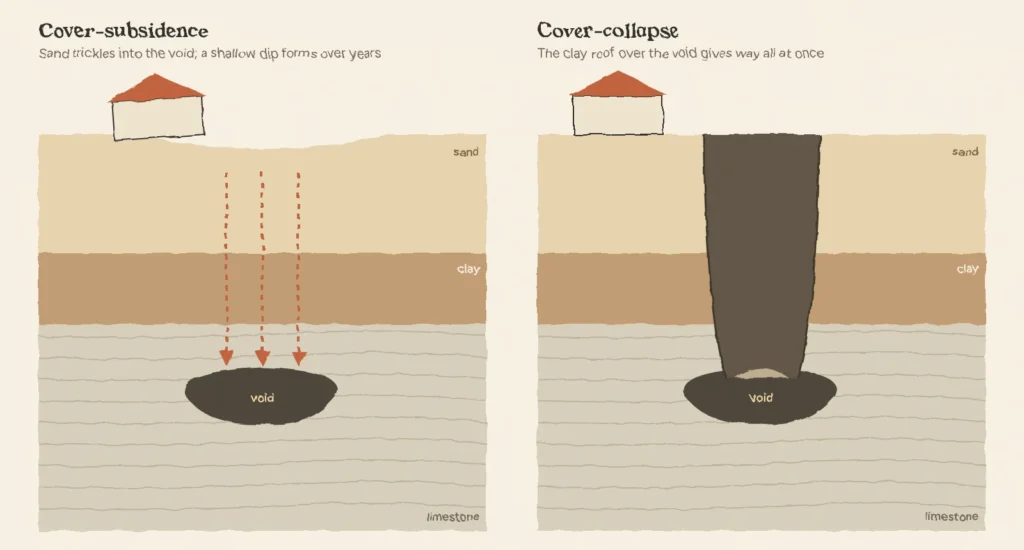
The same void in the limestone can show up two ways: a slow dip or a sudden hole.
Hernando County sits right in the middle of what people around Tampa Bay call sinkhole alley. When the Florida Office of Insurance Regulation counted 24,671 sinkhole claims statewide from 2006 through 2010 about two-thirds of them traced back to just three counties: Hernando, Pasco and Hillsborough (Insurance Journal). 10 Tampa Bay has reported that Spring Hill ranks first in the nation for verified sinkholes (WTSP).
A lot of locals still remember July 19, 2014. A sinkhole opened just feet from a woman’s front door at Eldridge Road and Van Allen Way and sent a crack through the entire house. Officials measured it at 30 feet deep and 105 feet wide. Four houses were evacuated (10 Tampa Bay News) and her home was condemned on the spot. Her family had 48 hours to move her out.
10 Tampa Bay went back to that street ten years later. The report below covers what happened that day and why Spring Hill gets so many sinkholes in the first place.
Two things in that report matter if you’re selling. First the house that was condemned in 2014 didn’t stay a ruin. It was remediated and someone else calls it home now. A sinkhole house can become a home again. Second the story shows how much of Spring Hill’s reputation came from the way insurance claims used to work. More on that in the insurance section below.
Most Spring Hill foundation trouble looks nothing like 2014 though. It’s slow. A crack that widens over a couple of summers. A floor that tilts just enough for a marble to roll toward the hallway.
Is It a Sinkhole or Just Settling?
Not every crack is a sinkhole and that’s worth saying plainly. The Florida Geological Survey lists plenty of other reasons a house settles: expansive clay, a buried stump rotting away, a broken sewer or septic line, fill dirt that wasn’t compacted well or old trash buried on the lot (FDEP). Plenty of Spring Hill homes from the 1970s and 80s have hairline cracks that are just concrete block doing what concrete block does.
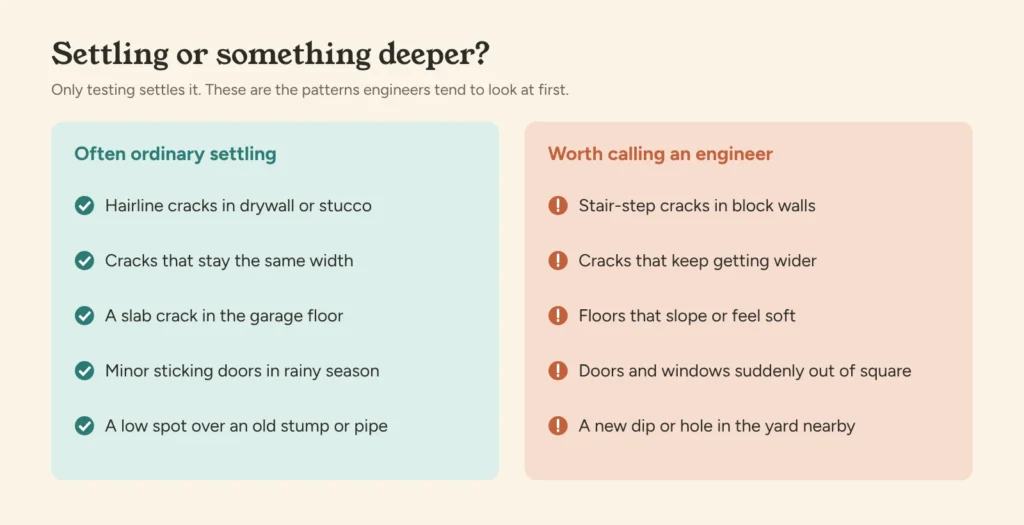
The only way to really know is testing. The FGS recommends a licensed engineering firm with a professional geologist on staff or a professional geology firm. That usually means soil borings and sometimes ground-penetrating radar. If you ever see walls sinking or sagging next to an open hole get out of the house and call your insurance adjuster. If anyone could get hurt call 911 first.
Why does any of this matter when you sell? Because the answer moves your price more than the crack itself does. A buyer’s inspector spots a stair-step crack in the block and writes “recommend evaluation by a structural engineer.” Now the buyer is guessing and buyers who guess tend to guess high on the repair bill. Its almost always better to know what you have before you put the house on the market.
What Florida Insurance Actually Covers
Before 2011 insurers in Florida often paid claims for “sinkhole-like conditions” whenever drilling turned up voids in the limestone. USF researchers found tens of thousands of subsidence-related claims over two decades and plenty were paid where there was no sinkhole at all. That history is a big part of why Spring Hill got its number-one reputation. Lawmakers rewrote the rules in 2011 and changed them again in 2016 (WTSP). Under today’s statute every homeowners policy must cover a catastrophic ground cover collapse. That sounds broad but it really isn’t. All four of these have to happen (Fla. Stat. 627.706):
1) The ground collapses abruptly.
2) There’s a depression you can see with the naked eye.
3) The house has structural damage including the foundation.
4) The house is condemned and ordered vacated.
Sinkhole loss coverage is the broader option and it’s just that: optional. Insurers have to offer it for an extra premium but they can require an inspection before they’ll write it. They can also attach a sinkhole deductible of 1, 2, 5 or 10 percent of your dwelling limit. Even with the coverage a claim needs real structural damage caused by sinkhole activity. You also generally have two years from the time you knew or should have known about the damage to give the insurer notice.
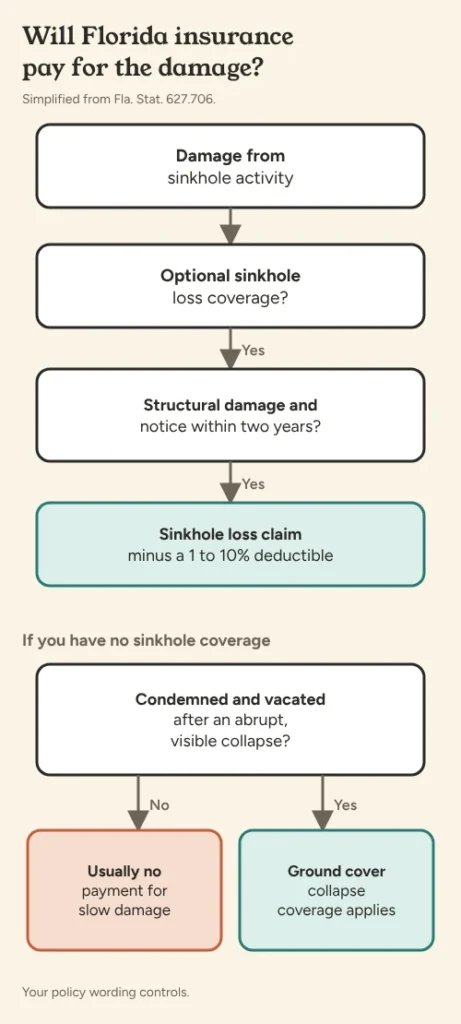
Which box you land in decides whether repair money exists at all.
Plenty of Spring Hill owners find out the hard way that all they had was collapse coverage. The house has cracks and a sloping floor but nobody condemned it so the policy pays nothing. That’s one of the most common reasons people decide to sell a house with foundation problems instead of fixing it. The repair money just isn’t there.
What You Have to Tell a Buyer
Florida leans hard toward disclosure. Ever since the state Supreme Court decided Johnson v. Davis in 1985 sellers have had to disclose known facts that materially affect a home’s value when the buyer can’t readily see them. Selling as is doesn’t change that. As is means you won’t fix things. It doesn’t mean you can stay quiet about them.
Sinkholes get their own rule on top of that. If an insurer paid a sinkhole claim on your home you have to tell the buyer before closing that a claim was paid and whether the full amount went into repairing the sinkhole damage (Fla. Stat. 627.7073). The insurer files the engineer’s report and certification with the county clerk. So does the engineer once repairs are verified. In Hernando that means the reports land in the official records at the clerk’s office in Brooksville where anybody can look them up. The statute is clear that recording one doesn’t create a lien or a title defect.

Every sinkhole claim leaves a paper trail and in Florida that trail is public.
Here’s the part people don’t expect. A stabilized home with a complete paper trail often sells more easily than a house with a crack nobody has tested. Buyers and their lenders want the engineer’s report, the repair contract, the completion certification and ideally a transferable warranty from the repair company. It’s the missing pieces that scare people off.
What the Repair Math Looks Like
Sinkhole repair isn’t one single job. Citizens Property Insurance describes two main tools and the engineer on the claim decides which one fits (Citizens). Grouting works on the ground. Cement grout gets pumped at high pressure through steel casings deep into the soil to fill voids and seal the top of the limestone while chemical grout is a polyurethane resin injected closer to the surface. Underpinning works on the house instead. Steel piers stabilize and relevel the foundation but they don’t repair the sinkhole underneath it.
The price gap is big. 10 Tampa Bay reported underpinning running about $20,000 to $30,000 while compaction and chemical grouting together ran roughly $70,000 to $100,000 or more (WTSP). Engineers can only estimate how much grout a void will swallow too. If the estimate comes in light the owner can owe tens of thousands more than the quote.
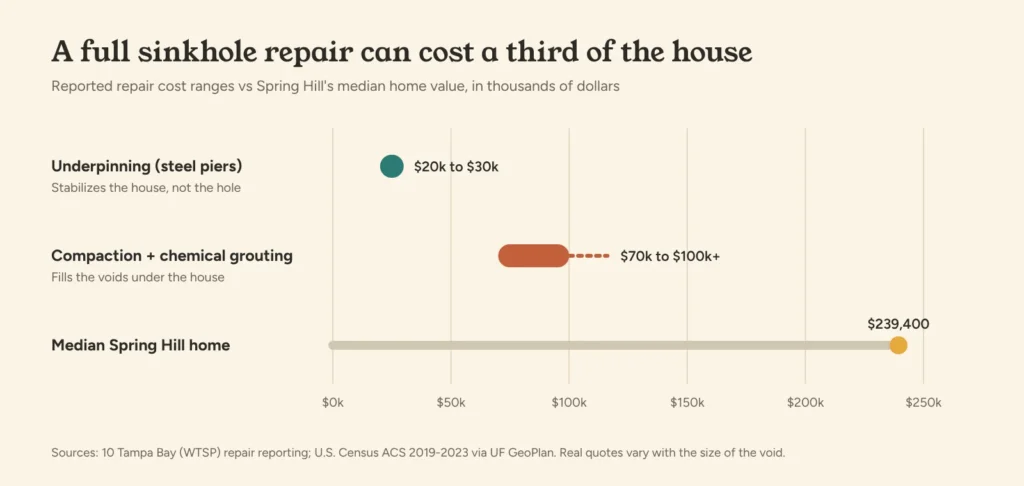
A grouting job alone can run close to a third of a typical Spring Hill home’s value.
Now set that next to what the house is worth. The median owner-occupied home in Spring Hill is valued at about $239,400 in the Census Bureau’s 2019-2023 survey (UF GeoPlan, ACS 2019-2023). A full grouting job can eat close to a third of that before anyone patches a single drywall crack. Then add cosmetic repairs, a new inspection and the months all of it takes.
How a Cash Sale Works for a House With Foundation Problems
The trouble with a retail sale is the buyer’s bank and the buyer’s insurance company. Lenders get nervous about structural damage and many Spring Hill homes are old enough that an insurer wants a 4-point inspection before writing a new policy. Put sinkhole history or an open crack in that report and the policy can get expensive or hard to find. When the buyer can’t get insured the loan stalls and you’re back at square one a month later.
Cash buyers skip that chain. Local home buyers who work Hernando County see sinkhole homes all the time. They already know what a grouting report looks like and they price the risk in up front instead of discovering it three weeks into escrow. If you want to sell your house without repairs here and still close on a date you can count on this is usually the way to do it.
Here’s roughly how it goes:
1) You share what you know – That means the cracks, any engineer’s report, any claim and what the money was spent on.
2) The buyer walks the house – Some bring their own engineer or contractor.
3) You get a written offer with a price and a closing date.
4) A Florida title company opens the file, checks the official records and handles the money.
5) You sign the written disclosure and the closing papers – The funds get wired to you.
What happens at a cash closing is simpler than most people expect. There’s no appraisal and no loan underwriting so the date usually holds. If you’re downsizing or moving closer to family this matters a lot. Nearly 23% of Spring Hill residents are 65 or older (UF GeoPlan, ACS 2019-2023) and plenty of them would rather not manage a six-figure repair project from somewhere like a daughter’s guest room in Ohio.
A quick word of caution. Not every sign on Mariner Boulevard or Commercial Way belongs to a real buyer. Ask for proof of funds. Insist on a licensed title company. Never sign a deed outside a closing. A reputable buyer won’t mind any of it.
Next Steps for Spring Hill Sellers
Whether the crack showed up last month or the grout went in fifteen years ago the first moves are the same:
1) Gather your paper trail – Find the engineer’s report, the repair contract, the completion certification and any warranty. If you can’t find them check the Hernando County official records since sinkhole reports get recorded there.
2) Call your insurer – Find out whether you have sinkhole loss coverage or only collapse coverage. Remember the two-year notice window.
3) Get the house tested if nobody has – A geotechnical engineer can tell you whether you’re dealing with a sinkhole or ordinary settling.
4) Compare two real numbers – Get an agent’s opinion of value and get a cash offer for your house. Seeing them side by side makes the decision much clearer.
5) Put your disclosure in writing – Tell the buyer about any paid claim and how the money was used. It protects you long after closing.
Spring Hill is a good place to live. There’s the waterfall at the old entrance on Spring Hill Drive, the mermaids up at Weeki Wachee and the quick drive down the Suncoast Parkway to Tampa. A house with foundation problems doesn’t change any of that. It just changes how you sell it.

The waterfall at US 19 and Spring Hill Drive has greeted people since the community’s early days.
If you’d like a no-pressure cash offer on a Spring Hill home with cracks, a sinkhole history or anything in between Fiesta Home Buyers can take a look. We’ll walk the house, read whatever reports you have and give you a written number with a closing date you choose.
Sources
• Spring Hill, Florida, Wikipedia
• Sinkhole FAQ, Florida Geological Survey (FDEP)
• Report Confirms Florida Sinkhole Insurance Woes are Deep, Spreading, Insurance Journal, Nov 2010
• Spring Hill No. 1 for sinkholes, 10 Tampa Bay (WTSP)
Sinkhole in Spring Hill, Bay News 9, July 2014
• Fla. Stat. 627.706, sinkhole and catastrophic ground cover collapse coverage
• Fla. Stat. 627.7073, sinkhole reports and seller disclosure
• Grout Versus Underpinning, Citizens Property Insurance
• Engineers: underpinning stabilizes but doesn’t repair sinkholes, 10 Tampa Bay (WTSP)
• Spring Hill CDP profile, ACS 2019-2023, UF GeoPlan Center