Can You Sell Your Home to Prevent Foreclosure in Lakeland, FL?
It usually starts small. A hospital bill, a slow season at work or a car that quits right when the insurance renewal hits. One mortgage payment slides. Then two. By the time the letters from the servicer turn into a thick envelope from a law firm, a lot of Lakeland homeowners feel like the house is already gone.
It isn’t. If you’re behind on payments and wondering whether you can sell your home to prevent foreclosure, the short answer is yes. In Florida you can usually sell right up until the clerk files the certificate of sale after the auction. The longer answer is that the earlier you move the more options you have and the more of your equity you keep.
This article walks through how Florida foreclosure actually works, what your choices look like at each stage and how to sell without getting taken advantage of along the way.
A quiet street, a full mailbox and a notice on the door. Foreclosure usually looks like this long before it looks like an auction.
Why So Many Lakeland Homes Are in Foreclosure Right Now
If it feels like you’re not the only one on your street getting these letters, you’re right. In the first half of 2026 Florida had the highest foreclosure rate of any state at about 1 in every 373 housing units. The Lakeland metro area was worse. ATTOM ranked it second among all U.S. metros with at least 200,000 people at 0.48% of housing units with a foreclosure filing. That’s about three times the national rate of 0.16% (ATTOM Mid-Year 2026 Foreclosure Market Report).
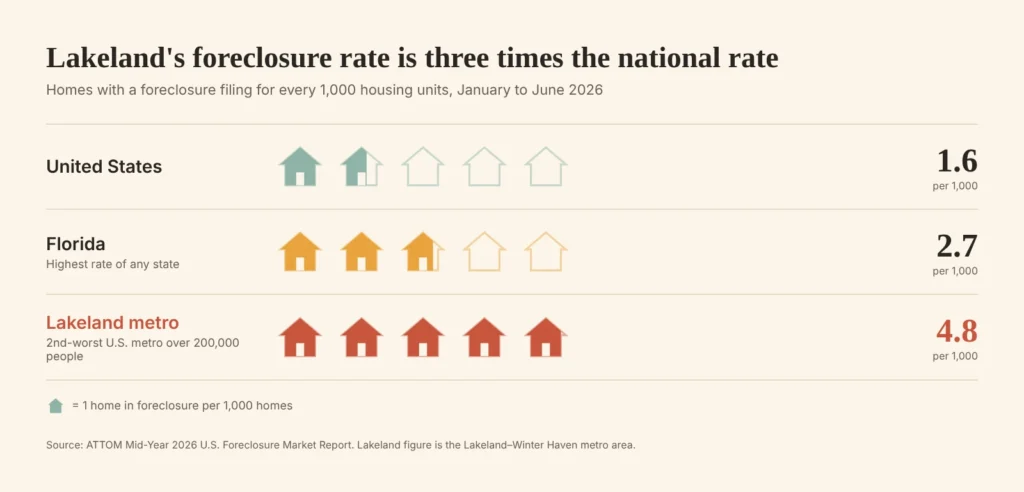
Each house stands for one foreclosure filing per 1,000 homes. Lakeland’s rate is three times the national rate.
In the second quarter alone Lakeland had the worst rate of any metro with more than 500,000 residents. One in every 421 housing units got a filing in just those three months.
This isn’t a new problem either. ATTOM’s year-end study for 2024 put the Lakeland area at the very top of the list for metros with at least 200,000 people. One in every 172 housing units saw some kind of foreclosure activity that year. What made it stand out even more is that foreclosure activity across the whole country actually fell about 10% in 2024. Lakeland was moving the other way.
This local news report covers that study and what Lakeland real estate pros made of it.
There isn’t one single reason but insurance comes up in almost every conversation. In the report Lakeland broker Bob Miller points to rising insurance premiums as a big driver. He says those costs pushed his own mortgage payment up 30%. That’s what happens when your insurance is paid through escrow. The loan didn’t change but the monthly bill did, and plenty of Polk County owners who bought along the I-4 corridor between Tampa and Orlando were already stretched. Add higher HOA dues in newer subdivisions and it’s easy to see how a budget that worked in 2021 stops working.
The same report includes a fair pushback. A co-owner of a Keller Williams office in Lakeland points out that a foreclosure filing isn’t the same thing as a completed foreclosure. A lot of owners catch up, sell or work something out before it ever reaches an auction. He also notes that Lakeland keeps growing in both population and home sales. Local agents describe it as a buyer’s market now because there’s more inventory than in past years.
Both things can be true. The area is healthy overall and a lot of individual owners are still in trouble. More inventory also means a listed house can sit longer than it would have a few years ago. If you’re working against a foreclosure clock that’s worth knowing before you pick how to sell.
The city itself is a bigger place than people from out of town expect. Lakeland had 112,641 people in the 2020 Census and the Census Bureau’s 2025 estimate puts it past 125,000. The median owner-occupied home is valued around $249,400 (U.S. Census QuickFacts). For a lot of owners that means there’s real equity sitting in the house. That equity is the whole reason selling early matters.
How the Florida Foreclosure Timeline Works
Florida is a judicial foreclosure state. That means your lender can’t just schedule an auction. It has to sue you in circuit court and win. For Lakeland homeowners that case runs through the Polk County courthouse in Bartow.
Here’s the order things happen in:
1) Missed payments – Federal rules generally keep a servicer from starting foreclosure until you’re more than 120 days behind. Those four months are your quietest and best window.
2) The lawsuit – The lender files a complaint and records a lis pendens, a public notice that the house is tied up in a lawsuit. Once you’re served you generally have 20 days to file an answer. Ignore it and the lender will likely get a default judgment (Nolo/AllLaw).
3) The case itself – If you respond the case moves through the court. This is the part that can drag on for months. Nationally the average foreclosure took 563 days to complete in mid-2026.
4) Final judgment and sale date – If the lender wins the judge sets a sale. Under Fla. Stat. 45.031 it has to happen 20 to 35 days after the judgment unless the lender agrees to a later date. Polk County foreclosure sales are held online.
5) Certificate of sale – Right after the auction the clerk files a certificate of sale. Your right to redeem the house by paying off the judgment generally ends at that point, or at a later date if the judgment sets one.
6) Certificate of title and possession – If nobody objects within 10 days the clerk issues the certificate of title. The new owner can then ask for a writ of possession and the sheriff can remove anyone still living there.
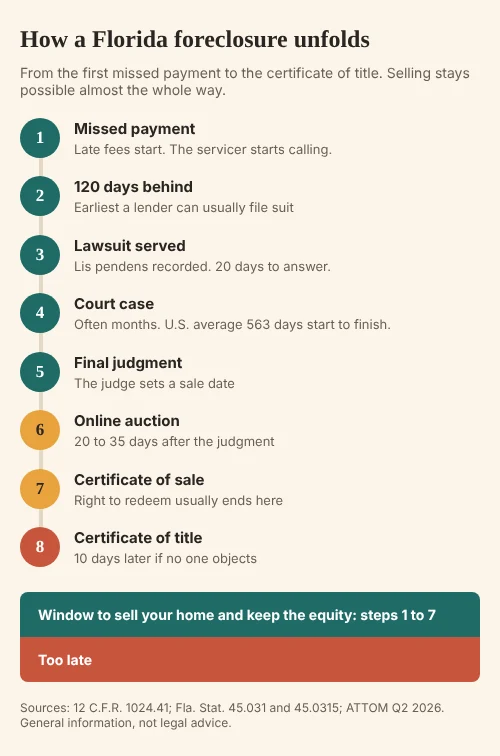
The window to sell stays open through step 7. After the certificate of sale it’s usually gone.
The important takeaway is that selling is possible at almost every step. But every month you wait adds interest, late fees and attorney fees to what you owe and leaves less time to find the right buyer.
Your Options Before the Auction
Selling isn’t the only way out and it isn’t always the best one. If you want to keep the house and the money problem was temporary, start by calling your servicer and asking about every program they have. Here’s how the main paths compare.
| Option | Keep the house? | Best when | Watch out for |
|---|---|---|---|
| Reinstate the loan | Yes | You can pay the past-due amount plus fees in one shot | Fees and attorney costs grow the longer the case runs |
| Loan modification or repayment plan | Yes | Your income is back and the problem was short term | Keep paying what you can while it's reviewed |
| Sell the house yourself | No | You have equity and want to keep it | Needs time to list, show and close |
| Sell to a cash buyer | No | You have equity and the sale date is close | Vet the buyer and compare the offer to market value |
| Short sale | No | You owe more than the house is worth | Lender approval can take months |
| Deed in lieu of foreclosure | No | You owe more and just want to hand back the keys | Lender has to agree; ask about any leftover debt |
| Let it go to auction | No | Nothing else works | Lost equity, credit damage and a possible deficiency judgment |
The short sale vs foreclosure question comes up alot. A short sale still hurts your credit but usually less than a completed foreclosure and you get some say in how it ends. A deed in lieu of foreclosure is similar. With both make sure the lender puts in writing whether it’s waiving the rest of the debt.
That last part matters in Florida. After a foreclosure sale on a one- to four-family home the lender has one year from the certificate of title to go after a deficiency judgment for the shortfall. For an owner-occupied home the deficiency is capped at the difference between the judgment and the home’s fair market value.
Selling Before the Sale Date: How the Money Works
The first question is simple. Do you owe less than the house is worth? If you do a sale pays off the loan and the rest is yours. If you don’t you’re looking at a short sale or a deed in lieu instead.
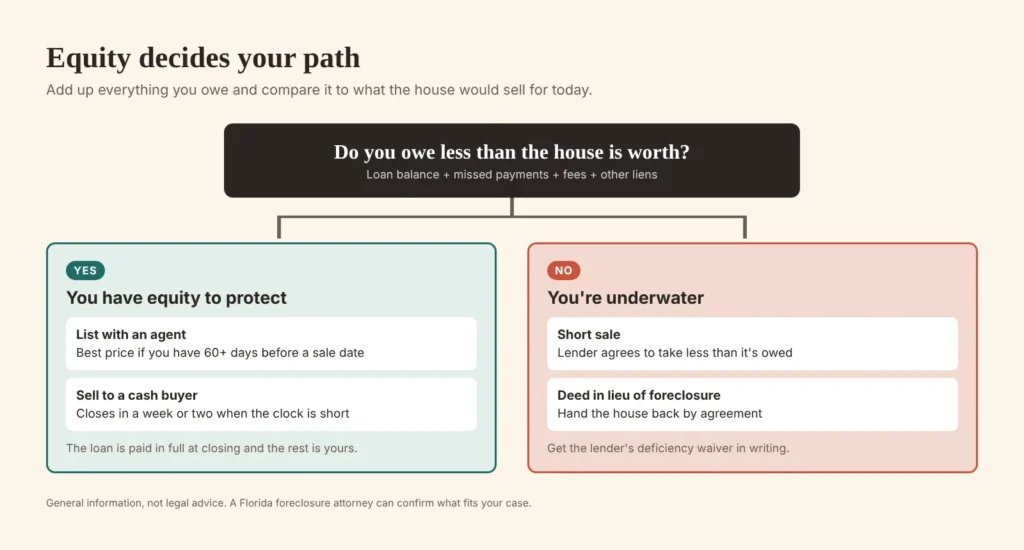
Add up everything you owe first. That one number points you down the right path.
When you sell during pre-foreclosure the lender doesn’t get to decide the price. It just gets paid. At closing the title company orders a payoff letter from your servicer. That number includes the unpaid balance plus missed payments, interest, late fees and whatever foreclosure costs have built up. Everything left after that and your closing costs goes to you.
Here’s a simplified example for a Lakeland house near the city’s median value. The numbers are made up but the structure is how every payoff works.
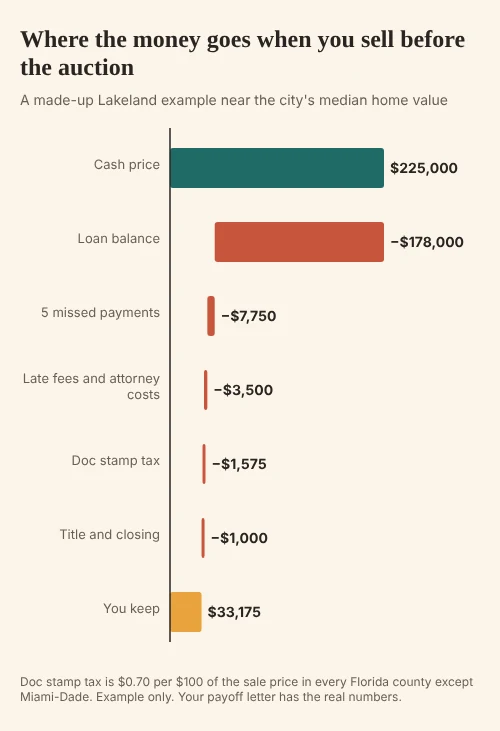
On a $225,000 cash sale the seller in this example walks away with about $33,175 after the loan, the arrears and closing costs are paid. Florida’s documentary stamp tax runs $0.70 per $100 of the price.
Compare that to letting the house go to auction. The lender usually opens with a credit bid for what it’s owed. If the house sells for more than the judgment the extra money is called surplus and the former owner can claim it. You have to file a claim with the Polk County clerk though. Under Fla. Stat. 45.032 money that’s still sitting there a year after the sale gets treated as unclaimed property (USFN). And surplus is rare when the lender bids its full judgment.
How long does it take to close on a house in foreclosure?
It depends on who’s buying. A buyer using a mortgage usually needs 30 to 45 days for the appraisal, underwriting and inspection. A cash buyer can often close in a week or two once the title company has the payoff. If your sale date is three weeks out that difference decides everything.
If you do get close to the sale date tell your lender’s attorney you have a signed contract. Lenders will sometimes agree to move the sale so a closing can happen since a payoff beats an auction for them too. Don’t count on it without a real contract and a closing date in hand.
It's Not Always the Mortgage: HOA Liens, Tax Liens and Debt
Plenty of Lakeland foreclosures don’t start with a bank at all.
HOA letters, tax notices and collection mail tend to pile up together. Any one of them can start the clock.
HOA foreclosure – In a lot of the newer subdivisions off Highway 98 and out toward the Polk Parkway, the homeowners association can foreclose on unpaid dues. Before it records a lien it has to send a written demand giving you 45 days to pay. Then it has to wait another 45 days after its notice of intent to foreclose before filing suit (Nolo). Those are two windows where a sale can wipe the whole thing out.
Property tax – Unpaid Polk County property taxes turn into tax certificates that investors buy. If the taxes stay unpaid long enough the certificate holder can push the house toward a tax deed sale. You can still sell a house with tax liens on it. The back taxes just get paid out of your proceeds at closing like any other lien.
Other debt – Some owners aren’t behind on the mortgage yet. They’re behind on everything else and wondering whether they should sell their house to pay off debt before it gets worse. That’s a real question and it’s worth sitting down with the numbers. Selling for financial reasons isn’t a failure. Sometimes moving from a house you’re fighting to keep into a rental you can afford is the thing that lets you breathe again. A HUD-approved housing counselor can walk through it with you for free.
Foreclosure Rescue Scams to Watch For
The lis pendens is public record. So the minute it’s filed your mailbox fills up with postcards, door hangers and letters that look a little too official. Some come from honest home buyers. Some don’t.
The Florida Attorney General’s office has warned about the same tricks for years (Florida Attorney General):
• Upfront fees – Under Florida law a company helping with a loan modification can’t charge you before the work is done. That includes fees called a “forensic audit.”
• “Stop paying your mortgage.” – A real modification never requires that. It just digs the hole deeper.
Lease buyback deals. You sign the deed over and rent the house back with a promise you can buy it later. Often the promise is impossible to meet and your equity is gone.
• Bait and switch paperwork – You think you’re signing new loan documents. You’re actually signing away the deed.
• Fake government ties – Unsolicited calls or mail claiming to be a government program.
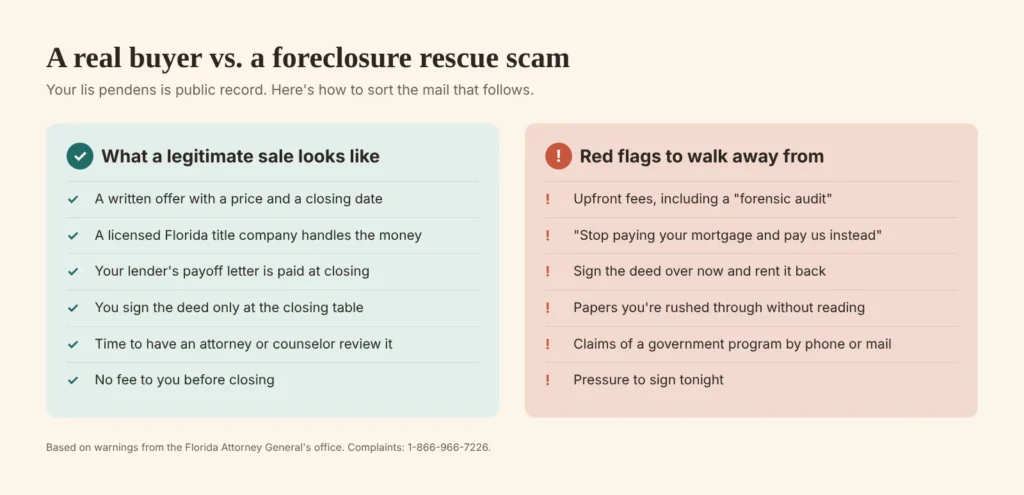
Keep this next to the mailbox. Anything on the right side is a reason to hang up.
A reputable buyer will put an offer in writing, use a licensed Florida title company for the closing and never ask you to sign a deed anywhere but at that closing. If someone’s pressuring you to sign tonight that’s your answer. You can check a company for complaints through the Attorney General’s hotline at 1-866-966-7226.
What to Do This Week
If you’re in a foreclosure or close to one here’s a short list to start with:
1) Open every letter – Write down the date you were served. The 20 days to answer runs from there.
2) Get your payoff and reinstatement numbers from the servicer in writing
3) Find out what the house is worth – Look at recent sales on your street or ask an agent for a quick opinion.
4) Talk to a Florida foreclosure attorney or a HUD-approved counselor before you sign anything with anyone –
5) Decide whether you’re keeping or selling – If it’s selling get more than one written offer and compare it to the market value.
Whether your house is a bungalow in Dixieland, an older place a few blocks from the swans on Lake Morton or a newer build out past South Florida Avenue, the clock works the same way. The earlier you act the more of your money stays with you.

Dusk over Lake Mirror from the promenade. Lakeland is worth staying in even when the house isn’t.
If you’d like to get a cash offer for your house Fiesta Home Buyers can look at your situation and give you a number in writing with no obligation. We’ll work with your lender’s payoff and a licensed title company. And if you’ve got enough time and equity to list with an agent and come out ahead, we’ll tell you that too.