Need to Sell Your House Fast for Cash in Arcadia, FL? Here's What Actually Happens
If you’ve lived in Arcadia for any length of time you know the town doesn’t move fast and most people like it that way. Saturday mornings on Oak Street, antiques stacked along the sidewalk, somebody’s pickup idling outside a café. Rodeo weekend at the Mosaic Arena is about as hectic as it gets around here.
Selling a house is a different story. Sometimes life hands you a deadline and the slow pace that makes Arcadia a nice place to live can make it a frustrating place to sell. We hear from homeowners in DeSoto County who need out in weeks, not months. A new job up in Tampa. A parent’s house that’s been sitting empty since the funeral. A place on the west side of town that took on water from the Peace River and never quite dried out right.
If you’re searching “sell my house fast cash” from somewhere near US 17 and State Road 70, this one’s for you. We’ll walk through how a cash sale works here, what it costs, what to do with a vacant house in the meantime and when it makes more sense to list with an agent instead. (Yes, sometimes that’s the better move. We’ll get to it.)
Why Arcadia Homes Don't Always Sell on a Normal Timeline
Arcadia is a small city, about 7,400 residents at the 2020 census. That matters when you’re selling. There are fewer buyers walking through open houses than you’d find in Sarasota or Port Charlotte, and the ones who do show up are usually counting on a mortgage.
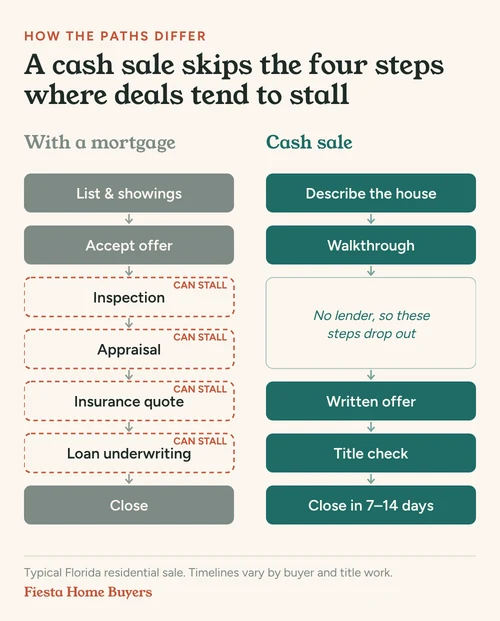
Financing is where things slow down. A conventional or FHA lender is going to send an appraiser and they’re going to want an inspection. If the roof is old or if there’s a soft spot in the bathroom floor, or even if the electrical panel is one of those brands insurers won’t touch the deal can stall or fall apart completely. Florida’s insurance market hasn’t helped. Plenty of buyers have walked away from contracts after getting a homeowners quote that wrecked their monthly budget.
Then there’s the housing itself. A lot of Arcadia’s homes have some age on them. The Arcadia Historic District covers roughly 3,400 acres around downtown and many of the brick buildings there went up after the Thanksgiving Day fire of 1905 burned out four blocks of the business district. Older neighborhoods have charm. They also have cast iron drain lines, original wiring and decades of put-it-off-till-next-year maintenance that an inspector will find in about twenty minutes.
None of that means your house won’t sell. It just means the traditional route can take a while and can come with surprises.
How a Cash Sale Actually Works
A cash buyer skips the lender. That’s really the whole difference, but it changes alot about the process.
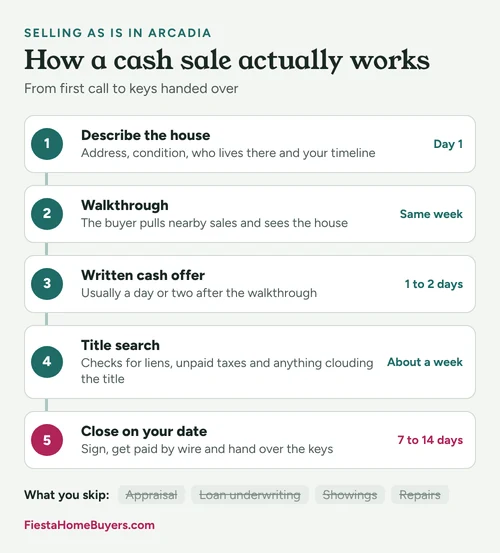
Here’s the usual sequence:
1. You reach out and describe the property. Address, rough condition, whether anyone’s living there, what your timeline looks like.
2. The buyer pulls comparable sales and usually walks through the house, sometimes the same week.
3. You get a written offer. With a legitimate cash buyer that often comes within a day or two of the walkthrough.
4. If you accept, a title company opens the file and checks for liens, unpaid taxes and anything else clouding the title.
5. You close on a date that works for you. That can be as quick as seven to fourteen days, or you can push it out if you need time to pack.
No appraisal. No loan underwriting. No buyer’s lender demanding a new roof before they’ll fund. When people ask about the quickest way to sell a house this is usually it.
The tradeoff is price. Cash home buyers who purchase as is are taking on the repairs, theholding costs and the risk of reselling, so the offer will typically come in under what a fully fixed-up house might list for. Anyone who tells you different is either selling you something or hasn’t run the numbers. The real question isn’t whether a cash number is lower than retail. It’s whether it’s higher than what you’d actually net after repairs, months of carrying costs and commissions.
What Selling "As Is" Means in Practice
As is means what it sounds like. You don’t fix the roof. You don’t replace the AC that’s been limping along since 2015. You don’t haul out the shed full of stuff your uncle collected for thirty years. A buyer purchasing a house as is for cash takes it in whatever condition it’s in on closing day.
That matters here more than in most towns. When Hurricane Ian came through in late September 2022, it passed over Arcadia as a Category 3 storm and the Peace River flooded homes and roads all over DeSoto County. Part of State Road 72 collapsed. Canoe Outpost which has been putting people on the river for more than fifty years lost its offices and a campground full of RVs. Some homeowners rebuilt properly. Others patched what they could and have been living with it ever since.
If your house had water in it you might be dealing with some of this:
• Drywall that was cut out and replaced in a hurry, or never replaced
• Moisture under the flooring that keeps coming back
• A flood history that has to be disclosed to any buyer
• Insurance that’s gotten expensive or hard to renew
A retail buyer with a lender may run from that list. A cash buyer who works with flooddamaged properties won’t necessarily. They’ll price it in, sure, but they won’t make you rip out the floors first.
Closing Costs for Sellers in Florida
A lot of homeowners don’t think about closing costs until they see the settlement statement, and by then its a little late to plan around them. On a traditional sale Florida sellers commonly pay some version of the following:
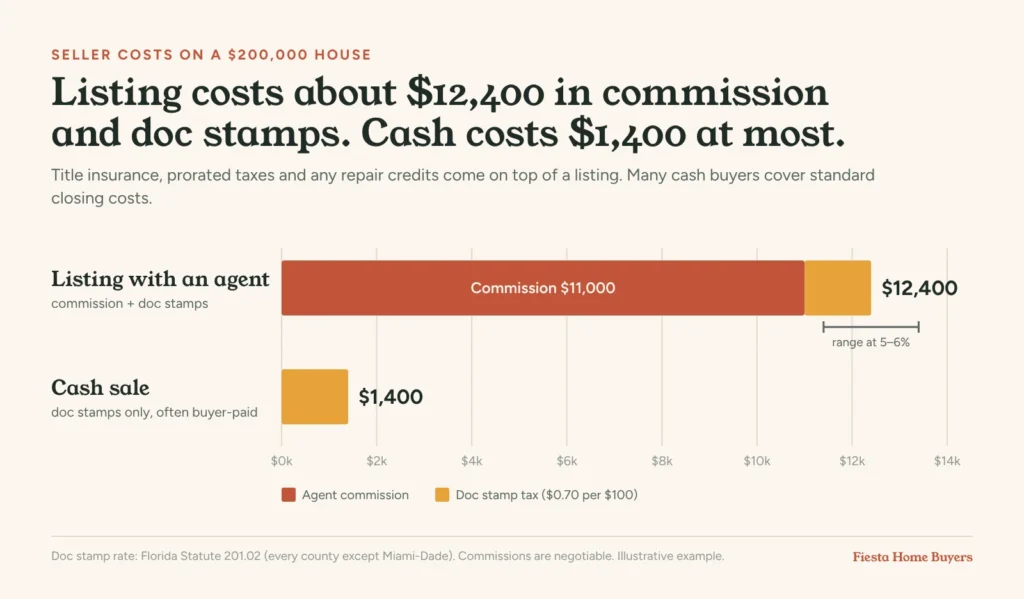
• Documentary stamp tax on the deed. In DeSoto County, like every Florida county except Miami-Dade, it’s 70 cents per $100 of the sale price. On a $200,000 sale that’s $1,400.
• Real estate commissions. These are negotiable and have been shifting since the 2024 national settlement but a combined 5 to 6 percent is still common. On that same $200,000 house, figure $10,000 to $12,000.
• The owner’s title insurance policy. Who pays for it varies by county and by contract in Florida, so you need to ask.
• Prorated property taxes, any HOA estoppel fees and the payoff of your mortgage or other liens.
• Repair credits a buyer negotiates after their inspection.
When you sell your house for cash to an investor a good chunk of that shrinks or goes away. There’s no commission because there’s no listing agent. Many cash buyers cover the standard closing costs as part of the deal, and there are no inspection-driven repair credits. So when you compare offers, compare what lands in your bank account, not the headline price.
How to Turn Off the Water to a House Before It Sits Empty
This one sounds off topic, but it comes up all the time. People selling an inherited house or those who’ve already moved out, need to know how to turn off the water for a house that’s going to sit. One burst supply line under a sink can soak a floor over a weekend and nobody’s there to notice.
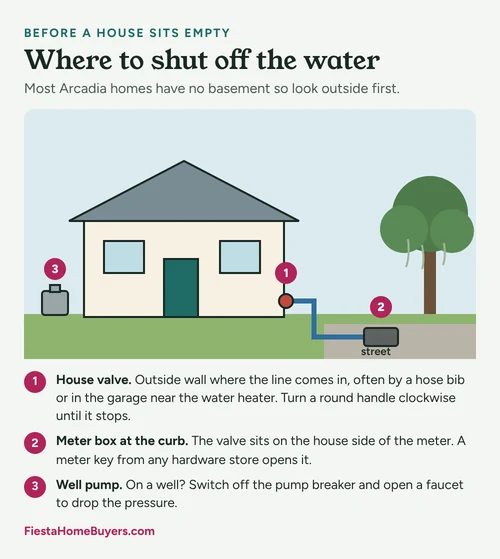
Most homes in Arcadia don’t have basements so the shutoff is usually easier to find than it would be up north. Check these spots:
1. The main shutoff at the house – Look on the outside wall where the water line comes in, often near a hose bib or in the garage close to the water heater. It’s usually a round handle or a lever.
2. The meter box by the street – If you’re on city water there’s typically a box in the ground near the curb with a valve on the house side of the meter. You may need a meter key which any hardware store sells for a few bucks.
3. The well pump – If you’re on a well, which is common out in the county, turn off the breaker for the pump and then open a faucet to bleed off the pressure.
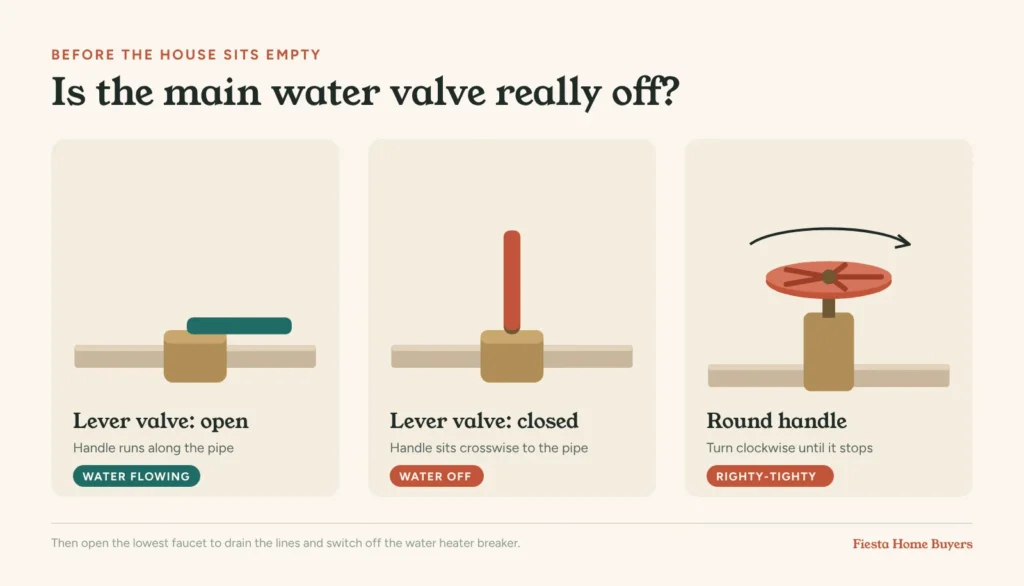
Turn a round handle clockwise until it stops. A lever valve is closed when the handle sits crosswise to the pipe. Then open a faucet at the lowest point in the house and let the lines drain. If you don’t trust the old valve on the house to hold, call your water provider (for most in-town homes that’s the City of Arcadia) and ask them to shut it off at the meter. While you’re at it, flip the breaker for the water heater too. An electric heater running with no water coming in can burn out its element .
Is a Cash Sale the Right Call for You?
Not always. If your house is in decent shape you aren’t in a rush and you can put up with a few showings, listing with a local agent may get you more money. Some folks sell without a realtor entirely as a for-sale-by-owner, which can work if you’re comfortable handling contracts, disclosures and negotiations on your own.
A cash offer tends to make the most sense when:
• The house needs repairs you can’t or don’t want to pay for
• You inherited it and you’re working through probate or splitting proceeds with siblings
• You’re a landlord who’s done with it and would rather not sell a rental property with tenants still living there
• You’re behind on payments and trying to sell before foreclosure
• The house is vacant and costing you insurance, taxes and lawn care every month
• You just want it finished on a date you pick
A good cash buyer will tell you plainly if they think you’d do better on the open market. If one pressures you to sign the same day, walk away. There are honest home buyers out there and a few who aren’t. The honest ones don’t mind you getting a second offer.
Questions to Ask Any Cash Home Buyer
• Which title company are you using? A known Florida title company is a good sign.
• Who pays the closing costs?
• How long is the inspection period? A short window is normal. Thirty days with a clause that lets them back out for any reason is a red flag.
• Are you buying it yourself or assigning the contract? Some buyers are wholesalers who pass the contract on to another investor. That’s legal but you deserve to know up front.
What Closing Day Usually Looks Like
People tend to picture a long table and a stack of paper three inches thick. A cash closing is a lot less dramatic than that. Most title companies in Southwest Florida will let you sign in their office, at your kitchen table with a mobile notary or even remotely if you’ve already moved out of state. That last option comes in handy for heirs who live in Georgia or Ohio and inherited a house on the outskirts of town they’ve barely seen.
You’ll sign the deed, a settlement statement showing every dollar in and out and a few affidavits about liens and who’s living in the property. Bring a valid photo ID. If there’s a mortgage, the title company pays it off directly from the proceeds so you don’t have to coordinate with your lender yourself.
The money usually goes out by wire the same day or the next business day. One tip: never act on wiring instructions that come by email without calling the title company at a number you looked up yourself. Wire fraud on real estate closings is real and it doesn’t care how small the town is.
After that, you hand over the keys. If you need a few extra days to finish moving, ask for that before you sign. A lot of buyers will agree to a short post-closing occupancy if it’s in writing.
Selling Your Arcadia House Without the Runaround
Arcadia’s the kind of place where people still wave at each other from their trucks. Selling your house here shouldn’t feel like a high-pressure pitch. Whether it’s a bungalow a few blocks off Oak Street or a place out past the Turner Agri Civic Center, Fiesta Home Buyers can look at your situation and give you a cash number with no obligation. Fill out the contact form on this site or give us a call. And if the numbers don’t make sense for you, we’ll tell you that too.