Sell My House As Is in Sebring, FL: Old Roofs, Insurance Trouble and Storm Damage
Sometimes it starts with a letter. Your insurance company wants a roof inspection or proof of a new roof, or it’s simply not renewing. Sometimes it starts with a knock on the door. A friendly crew is offering a free roof inspection and says your insurance will probably cover a brand new roof. Either way you end up at the kitchen table looking at the ceiling stain you’ve been meaning to deal with since the last storm.
That’s a common story in Sebring right now. A lot of homes around Lake Jackson and the neighborhoods off US 27 were built decades ago and many still have the roof that came with them or the one that went on after the 2004 hurricane season. Some came through Milton in 2024 with a few missing shingles and a tarp that was supposed to be temporary.
If you’re thinking you’d rather just sell your house as is than chase roofers, adjusters and door-knockers, you’re not alone and it’s a perfectly reasonable choice. This article walks through the Florida roof and insurance rules driving these decisions, the roofing scams state officials keep warning about, the other problems that tend to come along with an old roof, what “as is” really means under Florida law and how to run the numbers before you decide.
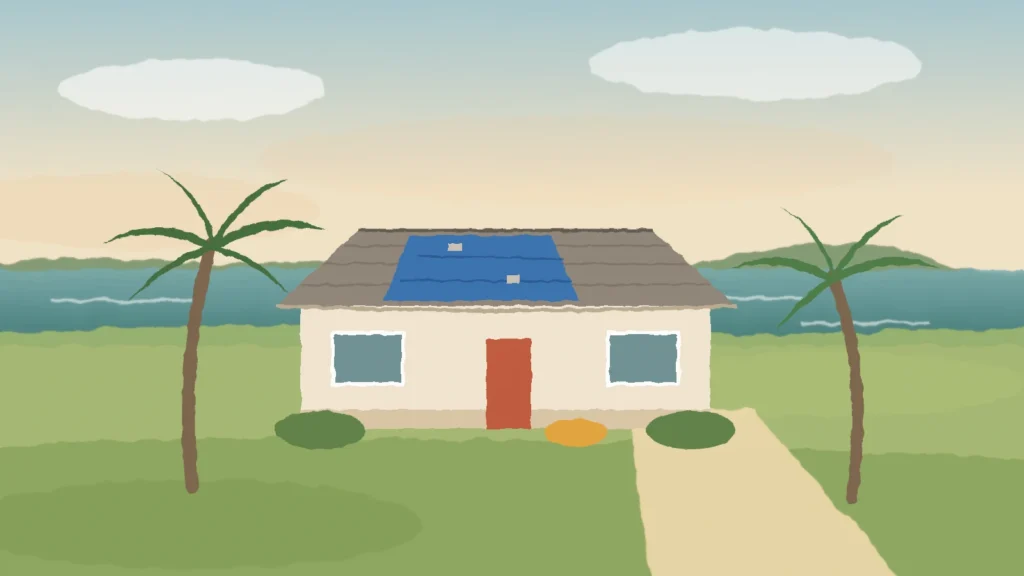
A blue tarp is supposed to be temporary. In a lot of Sebring yards it’s been up since the last storm.
Why the Roof Became the Deal-Breaker in Sebring
Sebring is a town where people stay put. The Census Bureau counts 10,729 residents as of 2020 and about 26.4% of them are 65 or older. The median owner-occupied home is valued around $191,600 (U.S. Census QuickFacts). Long ownership is great for a neighborhood. It also means a lot of roofs that haven’t been touched in twenty years or more.
About one in four Sebring residents is 65 or older. Long ownership often means a long-lived roof.
Storms keep testing those roofs. When Milton crossed Florida in October 2024 the National Weather Service recorded a peak gust of 73 mph at Sebring Regional Airport and confirmed five tornadoes elsewhere in Highlands County (NWS Tampa Bay). That isn’t enough to flatten a house. It is enough to lift tabs, crack old flashing and start a slow leak you won’t notice until the drywall turns brown.
The bigger pressure is insurance. Florida carriers look hard at roof age before they’ll write or renew a policy. A buyer who needs a mortgage also needs insurance, so an old roof doesn’t just bother you. It can shrink your pool of buyers to the ones paying cash.
The Florida Roof and Insurance Rules Sellers Run Into
You don’t need to memorize the statutes. It helps to know the handful of numbers that decide whether your roof is a minor issue or the whole conversation.
The 15-year roof law
Under section 627.7011 of the Florida Statutes an insurer can’t refuse to issue or renew a homeowner’s policy just because the roof is less than 15 years old. Once a roof is 15 or older the insurer has to let you get it inspected by an authorized inspector at your own expense before it can demand a replacement. If that inspection shows five or more years of useful life left, the company can’t refuse the policy based on roof age alone (Florida Statutes 627.7011).
That protection is real but it has limits. It only covers roof age. A roof with soft spots, curled shingles or active leaks can still be a reason to say no.
The 4-point inspection
Citizens Property Insurance, the state-backed insurer a lot of Highlands County owners end up with, requires a 4-point inspection on applications for homes more than 20 years old. A Florida-licensed inspector looks at four systems: roof, electrical, plumbing and HVAC. Citizens also wants shingle roofs older than 25 years and tile or metal roofs older than 50 to show at least five years of remaining life. If they can’t, you need proof of a full replacement before a policy gets written (Citizens Property Insurance).
So a 1990s ranch house near the Circle with original wiring and a tired shingle roof can fail on more than one line of that form. Many buyers’ insurers ask for the same report.
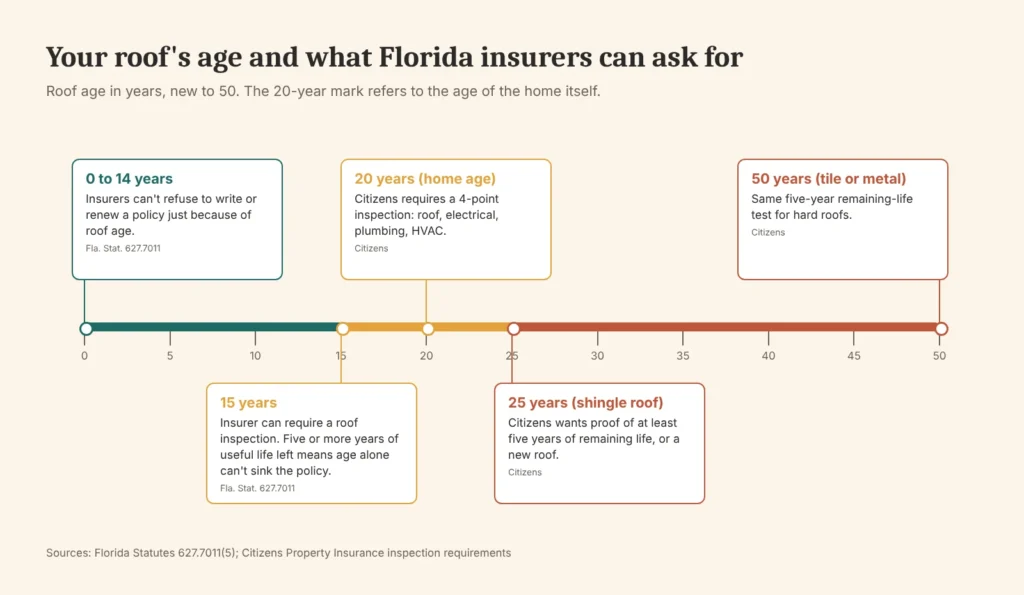
The older the roof, the more an insurer can ask for
Wind Mitigation
A wind mitigation inspection is the friendlier cousin. It documents features like roof-to-wall straps, impact windows and the roof deck attachment, and those can earn premium discounts. For a seller it’s a selling point when the house has good features and a non-issue when it doesn’t.
The 25% repair rule
For years Florida’s building code said that if more than 25% of a roof was repaired or replaced within 12 months, the whole roof had to be brought up to current code. That rule turned a partial storm repair into a full replacement. A 2022 law (section 553.884) changed it for roofs built, repaired or replaced under the 2007 Florida Building Code or later. Those roofs can now have just the damaged section fixed. In practice that means roofs installed after about March 2009. Older roofs are still likely stuck with the 25% rule (Jimerson Birr).
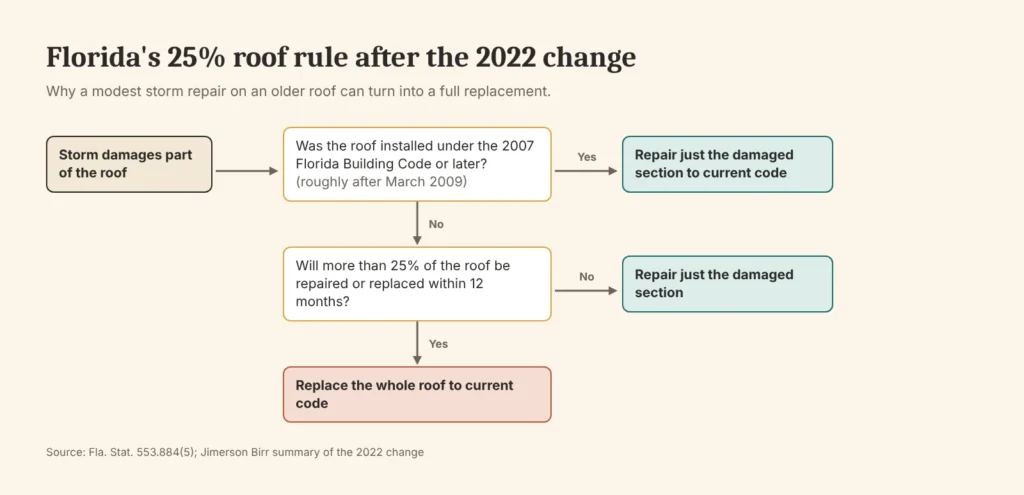
Roof installation date decides which branch you’re on
If your roof went on before 2009, a modest storm repair can still snowball into a whole new roof. That’s often the moment people start asking how to sell a house that needs work instead of fixing it.
Watch for Roofing Scams Before You Decide Anything
An old roof doesn’t just draw letters from your insurer. It draws knocks on the door.
The News4Jax report below aired while Jimmy Patronis was Florida’s chief financial officer (he has since moved on to Congress). It describes a pattern a lot of Sebring homeowners will recognize. A crew offers a free roof inspection and a new roof for next to nothing out of pocket. One Central Florida homeowner in the story says the same company came to his door three times. He turned them down every time, which is exactly what the CFO’s office tells people to do.
Florida’s CFO at the time explains why you shouldn’t sign anything a stranger brings to your door after a storm.
The part that should make you sit up is how these crews choose houses. According to the report they don’t just follow the weather. They look up county permit records to see when each house last had its roof replaced. If that roof is getting close to the end of its life, the house goes on the list. So if your roof is one of the older ones this article is about, a door-knocker may know its age before you do.
The real danger is the paperwork. The message in the video is short: don’t sign anything. A storm-damage or insurance form signed on the porch can hand control of your claim to a stranger. They can then bill your insurer whatever they want and burn through the money your policy was supposed to pay you.
Florida has tightened the rules since the worst years of roofing fraud:
• No more assignment of benefits on newer policies: Residential property policies issued on or after January 1, 2023 can’t assign post-loss benefits to a third party like a contractor (Jimerson Birr). Older policies may still allow it.
• No deductible games: A contractor can’t offer to waive or pay your insurance deductible or hand out gifts, cash or gift cards to get an inspection or a claim. Written roof-claim solicitations have to tell you you’re responsible for your deductible, and violations can bring fines up to $10,000 each (Florida Statutes 489.147).
• Roofers aren’t adjusters: A contractor can’t interpret your policy or adjust your claim unless they’re a licensed public adjuster.
• A 10-day exit: A roof contract signed during a declared state of emergency can be canceled within 10 days without penalty, as long as you send the cancellation in a way you can prove.
Those laws help but the video makes a fair point. New laws don’t stop someone from knocking. The best protection is knowing what a bad pitch sounds like.
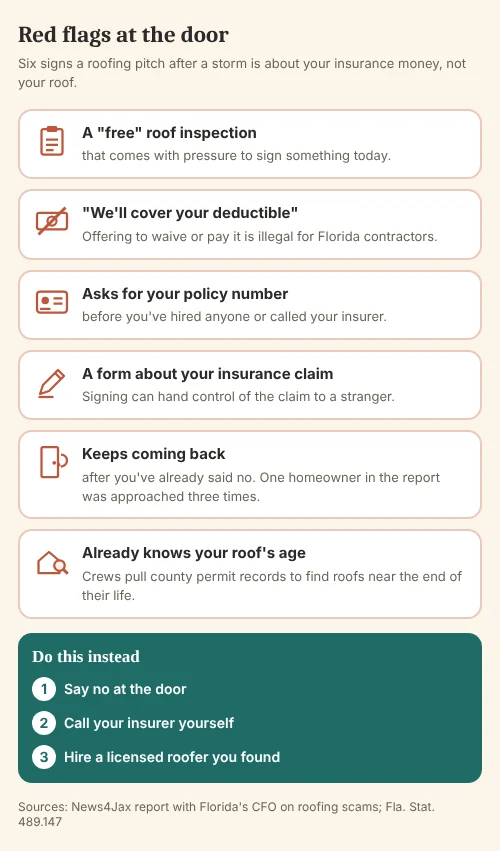
If a pitch hits two or more of these, close the door and call your insurer yourself.
If you’re planning to sell, a bad roof deal is the worst of both worlds. You can end up with a disputed insurance claim, an unpaid contractor threatening a lien or a cheap roof that fails the buyer’s inspection anyway. That’s one more reason some owners skip the roof project entirely and sell as is.
The Problems That Travel With an Old Roof
A roof rarely fails alone. Water finds its way in slowly and by the time you see it the trouble has usually spread. These are the issues we see most often when someone wants to sell a house with roof damage in Highlands County.

• Water damage – Stained ceilings, swollen fascia boards and soft spots in the roof deck. If you need to sell a water damaged house, expect any buyer’s inspector to trace the stain back to the source and ask how long it’s been there.
• Mold – Central Florida humidity plus a slow leak is all mold needs. Sometimes it’s a small patch in a closet. Sometimes it’s behind the drywall and in the attic insulation. Remediation costs climb fast once it’s inside the walls.
• Termite damage – Wet wood draws termites, and Florida’s warm climate means their active most of the year. Damage around eaves and window frames is common in older homes. Lenders often want a wood-destroying organism (WDO) inspection before they’ll fund a loan.
• Hurricane leftovers – Bent soffits, a lanai screen that never got fixed, a fence leaning toward the neighbor’s yard. Selling a house after hurricane damage is easier when you know exactly what’s damaged and what was repaired.
• The other three points – An old roof often sits on top of an old electrical panel, galvanized plumbing and an AC unit on borrowed time. Those are the other boxes on the 4-point form.
None of this makes a house unsellable. It does change who the buyer is and how the sale gets structured.
What "As Is" Really Means in Florida
Here’s the part people get wrong. Selling as is means you won’t make repairs and you won’t give credits for what the buyer finds. It does not mean you can keep quiet about problems you know about.
Florida’s rule comes from a 1985 state Supreme Court case called Johnson v. Davis. The court held that when a seller knows of facts that materially affect the value of the home and those facts aren’t readily observable or known to the buyer, the seller has a duty to disclose them (Johnson v. Davis). An as-is clause doesn’t erase that duty.
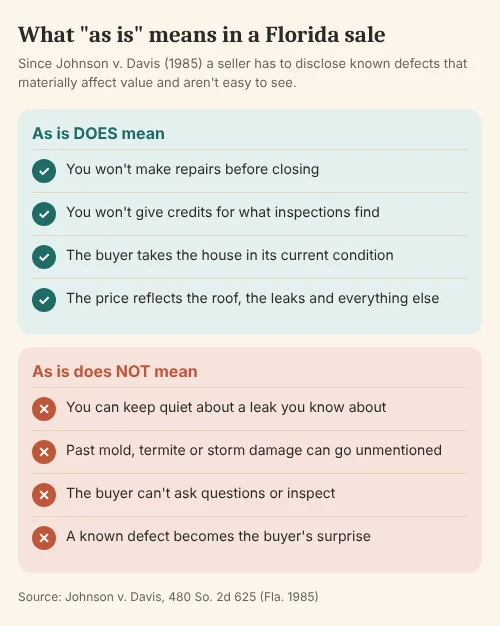
‘As is’ changes who pays for repairs. It doesn’t change what you have to disclose.
So if you know the roof leaks over the back bedroom, say so. If you had mold removed two years ago, say so. If a roofer told you the deck is rotten near the chimney, say that too. Disclosure protects you. A buyer who knew about the problem and bought anyway has a much harder time coming back after closing.
The good news is that a cash buyer who buys houses as is expects the problems. Your disclosure isn’t going to scare them off. It just goes into the price.
Fix the Roof First or Sell As Is? Run the Numbers
There’s no single right answer. If you have the cash, the time and the patience for contractors, fixing first and listing will usually put more money in your pocket. If you don’t have one of those three, selling as is can be the smarter move.
Start with the roof. RoofingCalc puts a Florida architectural shingle roof at roughly $4.50 to $8.00 per square foot, or about $9,000 to $16,000 for a 2,000 square foot roof. Tear-off and disposal can add $1,000 to $3,000, rotten decking runs $1.50 to $3.25 per square foot and permits add a few hundred dollars more (RoofingCalc). Then add whatever the leak did inside.
Here’s an example using Sebring’s median value. The repair and holding figures are illustrative. Your house will be different.
| Line item | Fix the roof, then list | Sell as is for cash |
|---|---|---|
| Sale price | $191,600 | $140,000 |
| Roof replacement (with tear-off) | −$15,000 | $0 |
| Ceiling, drywall and mold repair | −$5,000 | $0 |
| Agent commission (about 5.5%) | −$10,538 | $0 |
| Florida doc stamps ($0.70 per $100) | −$1,341 | −$980 |
| Three extra months of taxes, insurance and utilities | −$2,500 | $0 |
| Estimated net to you | $157,221 | $139,020 |
| Typical time to cash | 3 to 6 months | 2 to 4 weeks |
On paper fixing first wins by about $18,000. That’s real money and you should weigh it honestly. The question is what it takes to earn it. You’d need roughly $20,000 up front. You’d be counting on the roofer not finding more rot when the shingles come off and on a pre-2009 roof that could mean replacing the whole thing even if you only wanted a patch. You’d also need an insurer willing to cover the house while the work happens.
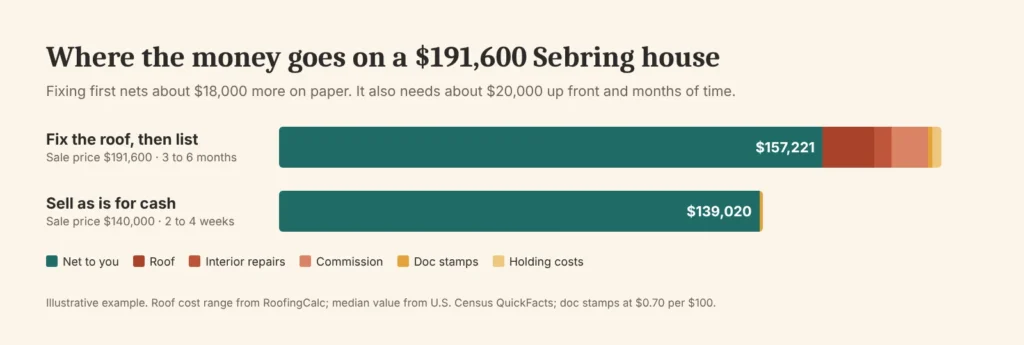
Same house, two paths. The gap is real and so is the cash it takes to close it.
When you sell your house without repairs to a cash buyer, the price is lower because the buyer is taking on all of that. What you get is a fixed number in writing, no out-of-pocket repairs and a closing date you pick. The closing costs for sellers usually shrink too. For some owners that tradeoff makes alot of sense. For others it doesn’t, and a good buyer will tell you that.
Selling Your Sebring House on Your Terms
Sebring has a way of holding onto people. Folks come for the 12 Hours of Sebring at the raceway or a winter by the lake and end up staying thirty years. The houses age right along with them. Whether yours is a block home a few streets off the Circle, a lakefront place on Lake Jackson or a ranch out toward Highlands Hammock State Park, the steps are the same.
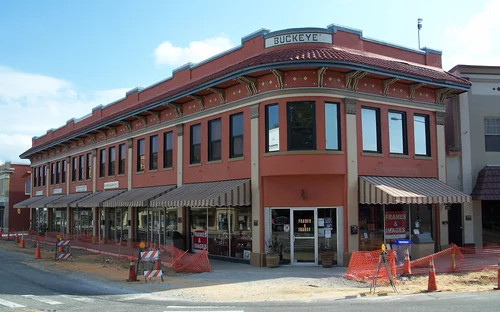
The Buckeye Building on the Circle in Sebring’s Downtown Historic District. Photo: Ebyabe / CC BY-SA 3.0.
1) Find out how old the roof really is. Check your county permit records. If a door-knocker can look it up, so can you.
2) Don’t sign anything a stranger brings to your door, especially anything about your insurance claim.
3) Get a roof inspection or a 4-point from an inspector you chose yourself. Even if you sell, the report tells you what you’re dealing with.
4) Write down every problem you know about so your disclosure is complete.
5) Price both paths: repair and list versus sell as is.
6) Pick the one that fits your money, your timeline and your patience.
If you’d like a written cash offer on a Sebring house with an old roof, storm damage, mold or anything else on that list, Fiesta Home Buyers can take a look. We buy as is so you won’t need to fix a thing, and we’ll never ask you to sign over an insurance claim. And if your numbers say you’d do better fixing it and listing with an agent, we’ll tell you that too.