Tired Landlord in Gainesville, FL? How to Sell a Rental With Tenants, Bad Tenants or Squatters
Buying a rental in Gainesville always looks like a sure thing on paper. There’s a giant university full of people who need somewhere to live, the leases fill up every August and the rent checks keep coming. For a while it works.
Then year six hits. The AC dies on a Saturday in July. A tenant off Archer Road stops paying and stops answering. The city sends a letter about your rental permit and an inspection. You find yourself driving past your own duplex on 13th Street wondering why you ever bought it.
If that sounds familiar you’re what the industry calls a tired landlord. It isn’t an insult. It just means the math and the headaches have tipped the wrong way. This article walks through how to get out cleanly in Florida, whether your tenants are great, terrible or not really tenants at all.
Why Gainesville Landlords Burn Out
Gainesville is a renter’s town in a way few Florida cities are. Only about 37.7% of homes in the city are owner-occupied according to the Census Bureau. Most of the rest are rentals (U.S. Census QuickFacts).
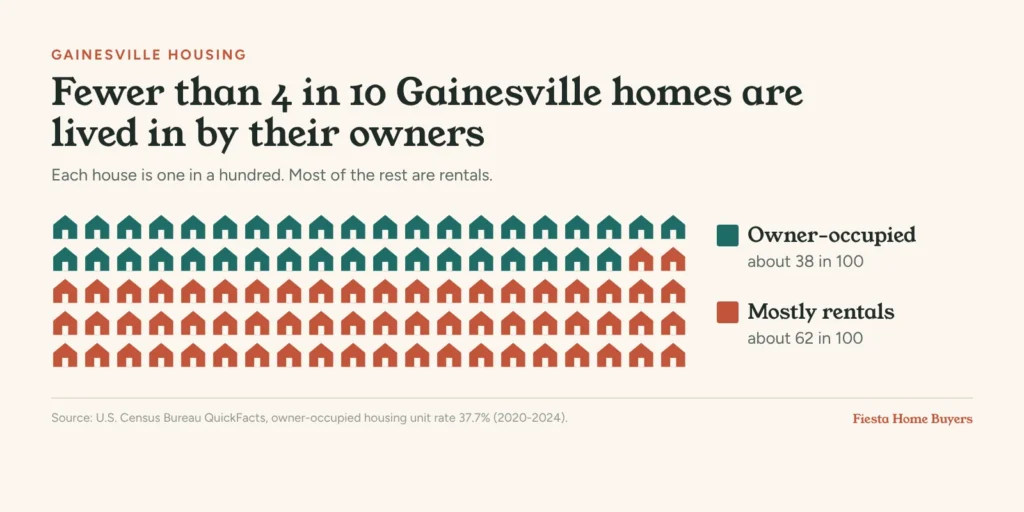
Every house here stands for one in a hundred. Gainesville’s owner-occupied rate is 37.7%.
That’s great for demand. It’s also why the city keeps a close eye on rentals. Gainesville requires a rental unit permit for anything rented 30 days or more, from single-family homes to quadplexes, and every registered unit can be inspected during each four-year cycle (WUFT). The program also brought energy efficiency standards for things like attic insulation, ducts and water heaters (Main Street Daily News). If your rental is an older house near the Duckpond or off University Avenue, getting it up to standard can mean real money.
Then there’s property tax. Ownwell puts the median bill in Gainesville around $3,088 a year at an effective rate near 1.36%, higher than the Florida median (Ownwell). Rentals don’t get the homestead exemption, so investors usually pay more than the owner next door.
Add turnover every August, a tight insurance market and the occasional 2 a.m. phone call and it’s easy to see why people want out. None of that means you made a bad investment. It might just mean the investment has done it’s job.
Selling a Rental With Good Tenants Still Living There
A lot of landlords assume they have to empty the house before they can sell it. In Florida you usually don’t.
A lease doesn’t end just because the property changes hands, unless the lease itself says the landlord can end it on a sale. The new owner steps into your shoes. Any security deposits and advance rent you’re holding transfer to the buyer along with an accounting of what each tenant has on credit, and the tenants don’t have to sign off on that (Florida Realtors).
That opens up a few ways out.
| Sell with tenants in place | Wait for the lease to end | Cash for keys | Keep it and hire a manager | |
|---|---|---|---|---|
| Timeline | As fast as a buyer can close | Until the lease runs out, often August | A few weeks if the tenant agrees | Ongoing |
| Who buys | Investors who want the rent | Any buyer, including owner-occupants | Any buyer | Not selling |
| Tenant disruption | Low | Low until move-out | Tenant moves early for a payment | None |
| Price impact | Investor pricing | Retail pricing possible after repairs | Costs you the payment | Manager typically takes a cut of rent |
| Best when | Good tenants, steady rent | Lease ends soon and the house shows well | You need it empty sooner | You still want the asset |
If your tenants pay on time and take care of the place, selling occupied is often the easiest move. An investor buying a Gainesville rental wants that rent roll. You hand over the keys, the leases and the deposits and you’re done.
If you’d rather sell to an owner-occupant for top dollar, timing matters. A month-to-month tenancy can be ended with at least 30 days’ notice before the end of a monthly period. A fixed lease generally runs to its end date. In a college town that often means waiting until the summer turnover.
When the Tenants Are the Problem
Now the harder version. The tenant who’s three months behind. The one with four extra roommates who aren’t on the lease. The one who stopped answering texts after you mentioned the inspection.
You have two basic choices. Fix the tenant situation first, or sell the house with the problem attached.
The Florida eviction timeline
Florida’s eviction process is faster than a lot of states, but it still has to be done by the book. For unpaid rent the landlord serves a three-day notice to pay or leave, which doesn’t count weekends or legal holidays. If the tenant doesn’t pay or move out the landlord can file in county court. Once served, the tenant has five business days to respond. If the tenant loses or doesn’t respond, the court issues a writ of possession and the sheriff gives about 24 hours’ notice before removing them (Korte & Associates).
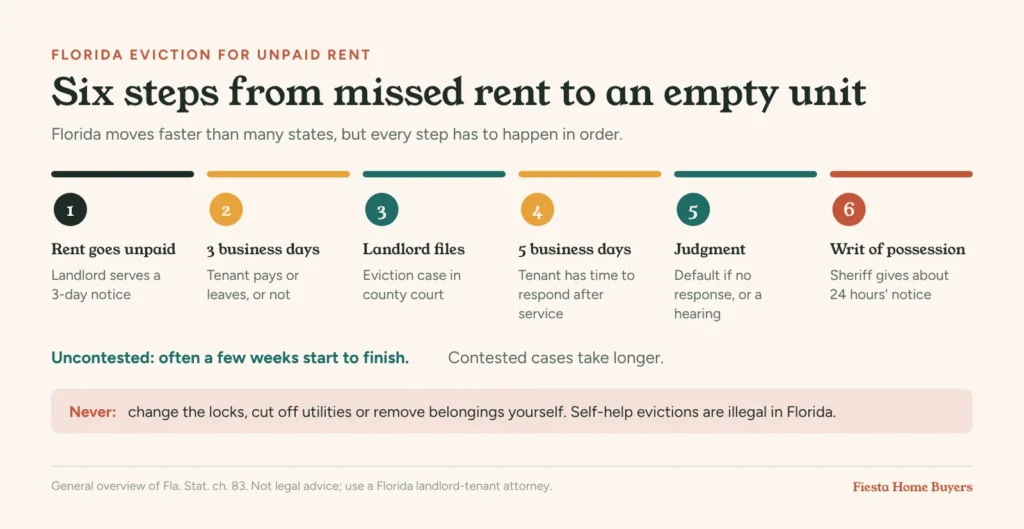
The steps have to happen in order. Skip one and you can end up starting over.
An uncontested eviction can wrap up in a few weeks. A fought one takes longer and costs more in filing fees, attorney time and lost rent. And whatever you do, don’t change the locks, shut off the power or haul their stuff to the curb yourself. Florida law doesn’t allow self-help evictions and it can cost you far more than the back rent.
Cash for keys
Sometimes the cleanest path is just paying the tenant to leave. You offer a set amount, say a few hundred dollars or the deposit back in full, if they’re out by a certain date and leave the place broom clean. Put it in writing. It feels backwards to pay someone who owes you money, but compared to a month of court dates and another month of vacancy, it’s often cheaper.
Selling with bad tenants in place
The third option is to sell the house as is, tenant and all. Most retail buyers won’t touch that. A cash buyer who deals with rentals might, because they’re pricing in the eviction or the buyout themselves. You’ll give up some price for that. What you get back is your weekends.
Squatters Are a Different Problem Now
Here’s one that used to drive Florida owners crazy. A house sits empty between tenants, somebody moves in without permission and suddenly you’re told it’s a civil matter and you need to go to court.
That changed on July 1, 2024. Under section 82.036 of the Florida Statutes, a property owner can ask the county sheriff to remove unauthorized occupants from a residential property without a full eviction, as long as certain conditions are met (Volusia Sheriff’s Office).
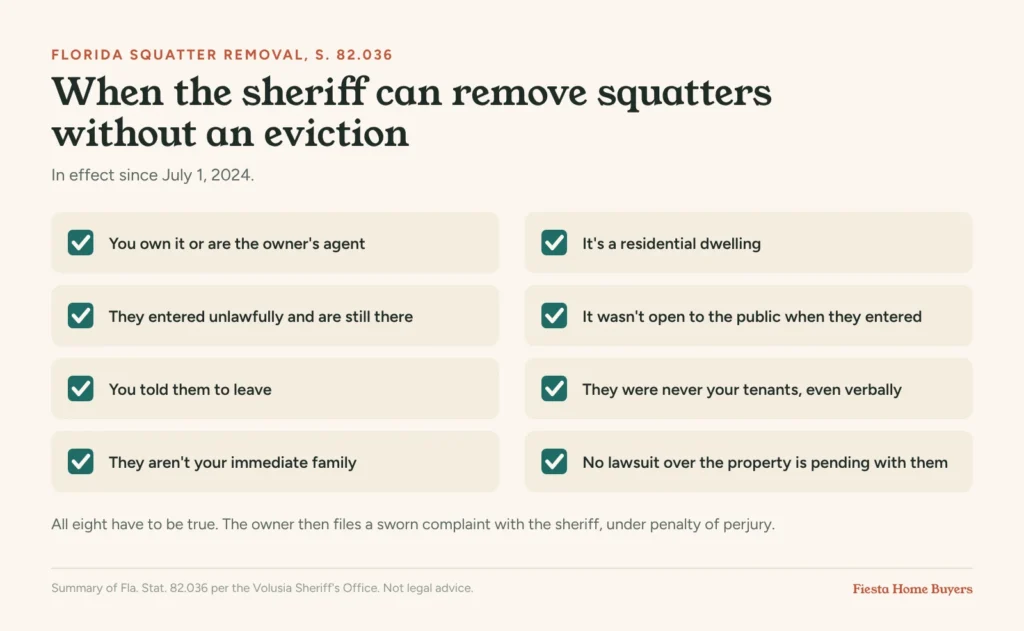
All eight boxes have to be checked before the sheriff can help under section 82.036.
The big one is that the people inside can’t be current or former tenants. If you ever rented to them, even on a handshake, this law doesn’t apply and you’re back to a regular eviction. They also can’t be your immediate family, and there can’t already be a lawsuit pending between you and them over the property. The owner signs the complaint under penalty of perjury, so the facts have to be right.
In Alachua County that request goes through the sheriff’s office. Have your ID, proof of ownership and any paperwork showing you told the occupants to leave ready before you call.
If your vacant rental has squatters and you’re not sure whether they ever had any kind of agreement with you or a previous manager, talk to a Florida landlord-tenant attorney before you file. Getting that wrong can turn a fast removal into a slow lawsuit.
Selling One Rental or Liquidating the Whole Portfolio
Some landlords are only done with one house. Maybe the student duplex near campus has been a grind while the place out toward Haile Plantation basically runs itself. Others want out completely and are thinking about how to liquidate a property portfolio all at once.

Selling several rentals together can save time. One buyer, one negotiation, sometimes one closing. Some investors will pay a fair price for a package of occupied Gainesville rentals because it’s a ready-made business. The tradeoff is that a package deal usually gets priced for the weakest house in it, so it’s worth getting numbers both ways.
A few money questions to bring to a CPA before you sign anything:
1. Capital gains – If the house went up in value, you’ll likely owe tax on the gain.
2. Depreciation recapture – The depreciation you took over the years usually gets taxed when you sell, which surprises a lot of landlords.
3. A 1031 exchange – If you want to stay in real estate but swap into something easier, like one newer property instead of three old ones, a like-kind exchange may let you defer the tax. The rules and deadlines are strict.
4. Timing – Closing in December versus January can move the tax bill into a different year.
None of this is tax advice. It’s just the list of things we’ve watched landlords wish they’d asked about sooner.
Getting Out on Your Terms
Gainesville will keep needing rentals. The question is whether you want to be the one providing them. Whether your place sits on a quiet street near the Thomas Center, a few blocks from Depot Park or out past Butler Plaza on Archer Road, the steps are about the same. Look at your leases. Look at your tenants. Pick the exit that fits.
If you’d like a cash offer on a rental with the tenants still in it, problem tenants included, Fiesta Home Buyers can take a look and give you a number in writing. And if your house would do better listed with an agent once the lease ends we’ll tell you that too.